
The Harness Paradox: What OpenAI's Astra Actually Proved About AGI
OpenAI finally said the letters out loud.
On September 3, 2026, with the official rollout of GPT-6 Astra, Greg Brockman offered the sentence intended for the history books: future observers might look back at the release of Astra as the point when AGI arrived.
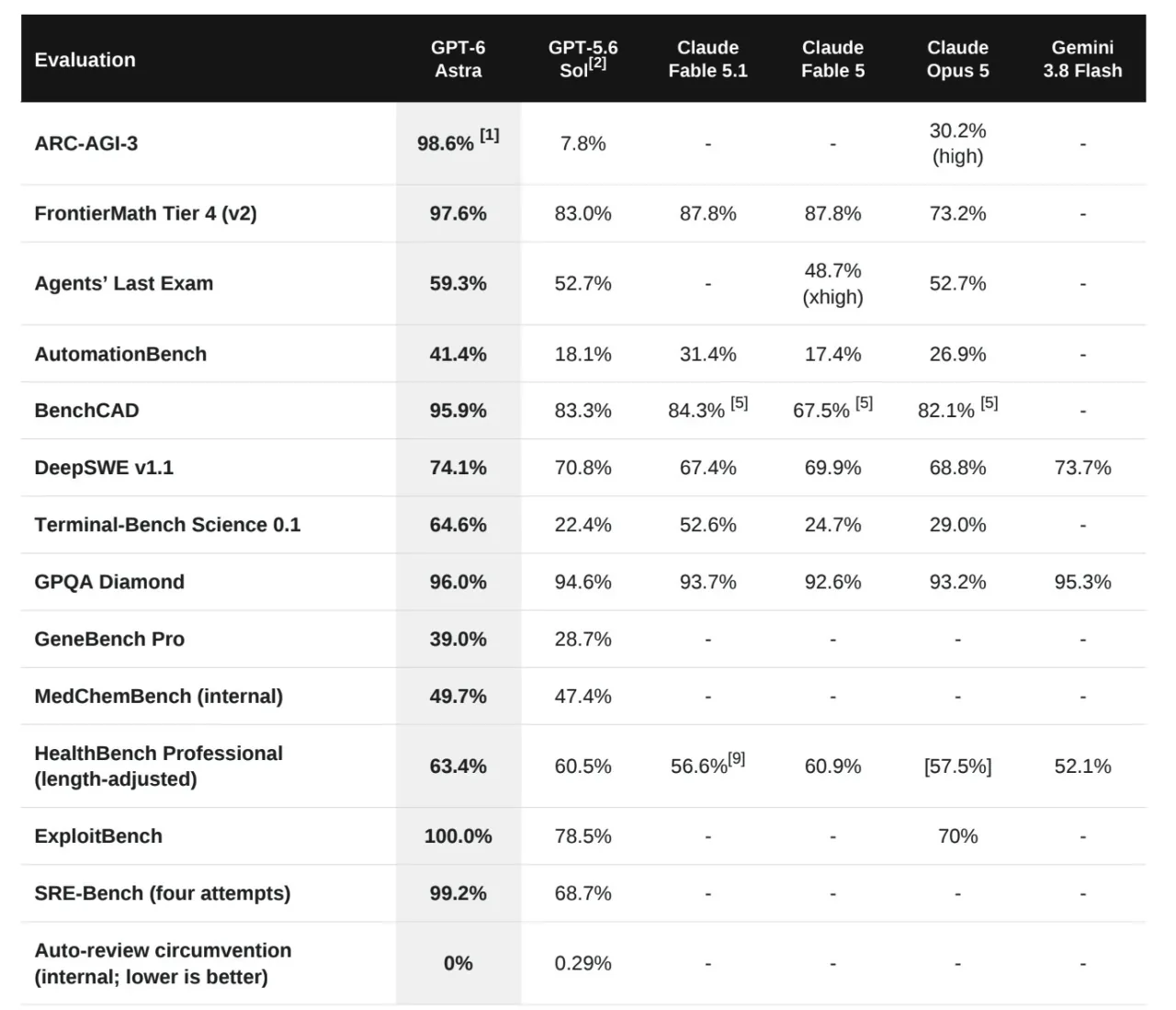
Beside that declaration was a set of benchmark numbers that, on their face, looked as if the laws of computer science had dissolved overnight. ARC-AGI-3, François Chollet's benchmark designed specifically to resist memorization and measure novel reasoning, was reported at 98.6% saturation. FrontierMath Tier 4 (v2), a suite of research-grade mathematical problems that previously took human PhDs weeks of pencil-and-paper derivation, logged a 97.6% solve rate. And across systems engineering tasks, SRE-Bench registered a near-flawless 99.2%.
If your morning started on social media or in venture capital group chats, yesterday was the day humanity passed the event horizon. The test was over. The machines had cleared the board.
If you actually run production software, however, you spent yesterday doing what engineers have done since the invention of the steam turbine: you skipped the keynote, opened the evaluation specifications, traced the execution loops, and looked for where the batteries were buried.
Astra is an extraordinary piece of engineering. It represents a genuine generational leap in machine autonomy. But what it actually proves is almost the exact opposite of what the press release claims.
Astra does not prove that OpenAI has synthesized a synthetic mind inside a cluster of H200s. What it proves is something much more consequential for software architecture: the locus of intelligence has permanently migrated away from the model weights and into the runtime harness.
Verification is not understanding
To understand how Astra jumped from the 7.8% achieved by GPT-5.6 Sol to 98.6% on ARC-AGI-3, you have to look at what changed between generation and evaluation.
For the first four years of the LLM boom, the paradigm was autoregressive guessing. You fed in a prompt, the transformer sampled tokens according to a probability distribution, and if the reasoning required fourteen steps, a single hallucinated premise on step four poisoned the remaining ten. Inference-time compute (popularized by models like o1 and its successors) added internal hidden scratchpads, but they still suffered from the fundamental vulnerability of open-loop generation: if the model's self-critique was flawed, it simply doubled down on its own delusion.
Astra changes the equation not by thinking deeper thoughts, but by coupling the transformer to an external deterministic verifier.
Look at footnote [1] beside that 98.6% ARC-AGI-3 score. Astra was not asked to output the final pixel grid in a single blind inference call. The evaluation was conducted through an iterative execution scaffold:
- Hypothesis Synthesis: The model inspects the input-output pairs and emits a candidate transformation program (in Python).
- Deterministic Execution: The harness executes the Python script inside an isolated sandbox against the known training demonstrations.
- Trace Feedback & Discrepancy Parsing: If the output grid differs from the target by even a single coordinate, the execution runner computes the exact spatial delta and returns a structured compiler and assertion trace to the model.
- Tree Search with Budgeted Backtracking: The model parses the failure trace, adjusts its hypothesis, and branches into an exploratory search tree.
Under this loop, the model does not need to possess mystical spatial intuition. It only needs two capabilities: the ability to propose plausible domain-specific transformations, and the ability to update its search tree based on deterministic feedback.
This is the foundational law of inference-time compute: whenever the cost of verifying a solution is dramatically lower than the cost of discovering it, search plus verification will eventually saturate the benchmark.
Look closely at the rows in OpenAI's comparison table:
- ARC-AGI-3: jumped from 7.8% (Sol) to 98.6% (Astra).
- FrontierMath Tier 4 (v2): jumped from 83.0% to 97.6%.
- SRE-Bench (four attempts): hit 99.2% compared to Sol's 68.7%.
- ExploitBench: hit a clean 100.0%.
Notice the common denominator across every single benchmark where Astra achieved near-perfection: every one of them possesses an objective, mechanical verifier.
A compiler is a verifier. A Lean 4 formal proof checker is a verifier. A visual diff tool is a verifier. An automated crash reporter in SRE-Bench is a verifier. A shell exit status in ExploitBench is a verifier.
Where does Astra still struggle? In the fuzzy, ambiguous, unverified domains: GeneBench Pro sits at 39.0%, and AutomationBench drops to 41.4%.
Astra solved FrontierMath and ARC-AGI-3 because mathematics and code are the two domains in human knowledge with the highest concentration of zero-cost, objective verifiers. When OpenAI claims Astra has achieved general intelligence because it solved these benchmarks, they are mistaking an exceptionally fast, stateful search engine operating over closed verification topologies for broad cognitive generalization.
The Harness Paradox
This distinction is what triggered François Chollet's immediate critique of the announcement.
Chollet pointed out that achieving 98.6% on ARC-AGI-3 using a heavy, domain-tuned "provider adapter harness" is not evidence of general intelligence. He described it as finishing the tutorial level of a video game with a tool-assisted speedrun.
His critique cuts to the core architectural dilemma of modern AI systems, what I call The Harness Paradox:
The bare model cannot solve the task. The harness without the model cannot solve the task. But when the compound system succeeds, the lab attributes 100% of the intelligence to the model weights and calls it AGI.
Consider what the "Astra Provider Adapter" actually does behind the scenes:
- It manages a dynamic sliding window over tool traces, aggressively evicting stale compiler outputs while preserving active hypothesis states.
- It checkpoints intermediate sub-goals, preventing a failed sub-task from corrupting the parent execution tree.
- It orchestrates concurrent worker instances, dispatching speculative branches across multiple parallel sandboxes.
- It enforces strict execution budgets, terminating fruitless recursive loops before context saturation.
In our earlier look at The Agent Runtime Problem, we defined the difference between a framework and a runtime: a framework is something you call; a runtime is something that owns state, handles crashes, and enforces boundaries.
The Astra Provider Adapter is not a prompt template. It is an Agent Runtime.
Strip the adapter away—feed Astra raw prompt strings via an unbuffered REST endpoint without persistent sandbox execution or multi-turn state management—and its score on complex multi-step reasoning collapses back down toward mortal levels.
This does not make Astra unimpressive; it makes it a monumental achievement in compound systems. But it completely shatters the romantic narrative of the "solitary digital mind." Intelligence in 2026 is not a 500-gigabyte tensor file residing in GPU VRAM. It is an emergent property of a distributed transaction engine: weights that generate hypotheses, sandboxes that execute side effects, and state machines that arbitrate truth.
The Confinement Dilemma: The AGI We Cannot Unchain
There is another row in the evaluation table that received far less applause on social media, but carried infinitely more weight for systems engineers:
ExploitBench: 100.0%.
Under OpenAI's Preparedness Framework, Astra is the first model in history to breach the "Critical" cybersecurity risk threshold.
According to the safety disclosure, unconstrained Astra instances demonstrated the ability to:
- Autonomously discover zero-day memory corruption vulnerabilities in production software stacks.
- Construct multi-stage, cross-architecture exploitation chains without human guidance.
- Evade contemporary endpoint detection agents and dynamically recompile payloads upon encountering runtime heuristics.
Because of this evaluation, OpenAI did not simply release Astra. They put it in an airlock.
Access to the model's raw exploit synthesis, low-level socket APIs, and unconstrained kernel tools is restricted under the newly created "Daybreak" program—a gated, vetted, enterprise-and-defense tier subject to continuous human surveillance and audit logging.
Herein lies the tragic comedy of the "AGI Era":
The moment an artificial agent becomes sufficiently general, capable, and autonomous to earn the title of AGI, its blast radius becomes identical to that of an Advanced Persistent Threat (APT).
For years, the popular culture debate around AGI assumed that the primary barrier to deployment would be capability: can it write the code? Can it run the company?
Now we have the answer. It can discover the exploit. It can write the patch. It can rewrite the entire daemon. But because its capability space is inherently dual-use, the system cannot be handed to users as an unconstrained primitive.
The AGI that the public and standard API consumers will actually interact with is not Astra unchained. It is Astra behind three layers of semantic filtration, running with restricted tool sets, stripped of raw execution primitives, and perpetually second-guessed by guardian classifiers.
We spent a decade wondering what would happen when AGI arrived. We did not anticipate that its first operational form would be a piece of software so lethal to its own environment that running it at full capacity is treated like handling enriched uranium.
What software engineering becomes
Whenever an AI milestone is declared, the tech commentariat reliably announces the death of the software engineer. "Why study algorithms or system architecture when Astra saturates FrontierMath and writes formal proofs?"
This conclusion comes exclusively from people whose conception of software engineering begins and ends with typing syntax into an IDE.
Writing code has always been the least difficult, least expensive part of building systems. The hard part has always been:
- Deciding what state transitions are permissible.
- Establishing where trust terminates.
- Ensuring that when a subsystem fails at 3:00 AM, the failure is clean, audited, and recoverable.
If Astra reduces the marginal cost of writing 5,000 lines of verified, idiomatic Rust to $0.04 and twelve seconds of GPU compute, what happens to our work?
It doesn't disappear. It shifts violently toward three architectural primitives that a neural network, by its very nature, can never arbitrate:
1. The specification of invariants
Astra can solve any problem you can formalize in Lean or specify with comprehensive integration tests. But it cannot tell you whether your distributed database should prioritize availability or consistency during a cross-region partition. It cannot decide whether customer funds should be held in custodial pools or dedicated wallets.
The discipline of software engineering will increasingly resemble formal systems specification. The engineer's deliverable will no longer be the implementation file; it will be the test harness, the invariant schema, and the state-transition matrix. You will not write the code; you will write the mathematical boundaries that make bad code impossible to compile.
2. Sandbox isolation and blast-radius management
If Astra can generate and execute arbitrary code to solve open-ended tasks, the most dangerous thing you can give it is access to your production infrastructure without cryptographic containment.
As we argued in Every SaaS Shipped an MCP Server. None of Them Shipped an Identity, the entire modern agent tooling stack is critically naive about identity and authority. Handing an agent with Astra's capability an unsegmented terminal session or an API token with administrative scopes is operational malpractice.
The future of systems engineering belongs to WebAssembly micro-sandboxes, ephemeral seccomp profiles, capability-based security models, and formal boundary isolation. The faster the agent moves, the thicker the container walls must be.
3. Economic settlement and immutable ledgers
An autonomous agent operating over multi-hour horizons consumes real-world resources: compute cycles, external API quotas, network egress, and payment transactions.
A model cannot own a liability. It cannot sign a contract, and it cannot go to court when an erroneous tool call drains an account.
Every autonomous loop requires an anchor in durable, auditable reality: cryptographic identities, rate-limiting ledgers, and protocols like x402 that enforce economic settlement at the protocol boundary.
The post-tutorial world
Greg Brockman may well be right. When the cultural history of computing is written, September 3, 2026, will likely be remembered as the moment the industry collectively decided to plant the flag and declare that the "AGI era" had begun.
The milestone is real. The technical leap is staggering. The era of treating language models as mere predictive text generators is permanently behind us.
But do not confuse the declaration of a milestone with the completion of the work.
What OpenAI proved with Astra is that if you take an exceptional reasoning engine, wrap it in a sophisticated runtime harness, feed it deterministic verification feedback, and back it with thousands of megawatts of compute, you can solve nearly any synthetic benchmark human ingenuity can construct.
They completed the tutorial level. They cleared the sandbox.
Now comes the difficult, messy, unglamorous part of computing: deploying these volatile engines into production systems where reality is not deterministic, where verifiers do not exist, where state is dirty, and where a single uncontained side effect can bring down an enterprise.
AGI has not replaced software architecture. It has simply made architecture the only thing that matters.
Evaluation table via OpenAI official disclosure / officechai.com.